
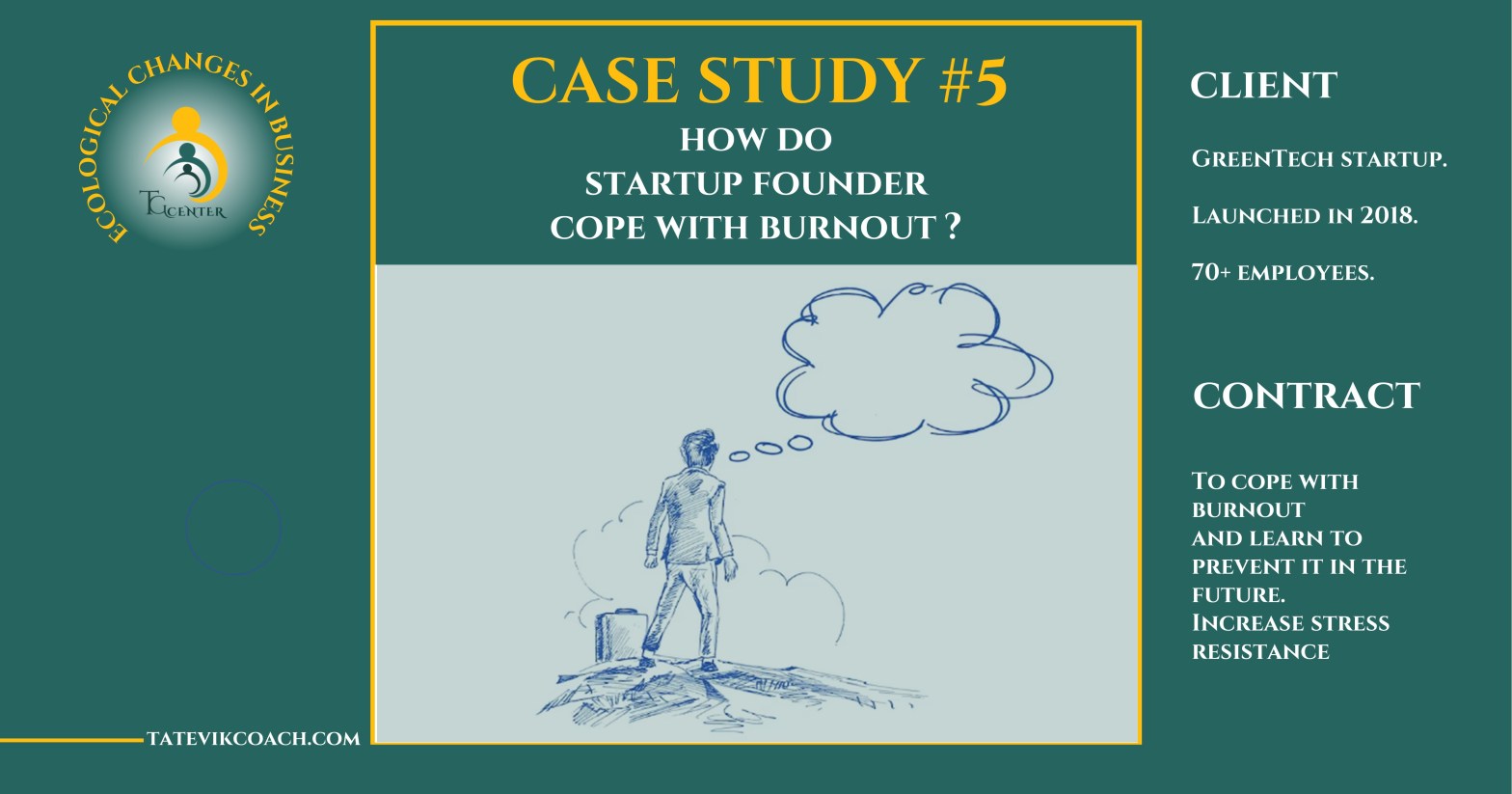
CLIENT
GreenTech startup. Launched in 2018. 70+ employees.
INLET CONDITIONS
CEO: I have a new project, but it seems there are problems with time. If I could just stretch it a little longer. But how else can I grab a time? My schedule is fully booked,- this is how we began our deep interview with the CEO of GreenTech Startup.
Me: Can you describe your day at work?
CEO: I work as all CEOs do, who have an international team in different time zones. 12-15 hours.
Me: Do you have any other interests except work?
CEO: Since we switched to remote work, I have to be in touch 24/7. It’s all mixed up: personal life, friends, work. But times are what they are, and we have to adapt to that. At least, Startup CEOs I know actually live this way.
Me: How many hours do you sleep?
CEO: 4-5 hours.
Me: How do you feel when you wake up most of the time?
CEO: I feel rather tired than rested, like my mind never stops working, because there are so many things to do every day. Sometimes I even have to work from bed. Unless, of course, I need to go to Zoom.
Me: Do you experience frequent mood swings or feelings during the day?
CEO: (long pause) Probably I can feel impulsive and annoyed, especially when someone delays with answers or deadlines. I’d like speed. People are sometimes too lazy and slow. Time is a luxury we rarely have at our disposal. Actually, who’s not getting tired or irritated? Being a startup isn’t easy. It’s hard.
Me: What is the hardest thing for a startup?
CEO: But what is easy? You take responsibility for the company and the team. There’re obligations to customers, partners, and investors. People have so many expectations of me. But what is about to happen in a startup is way beyond most people’s expectations. I mean, it’s not perfect, but still, it’s ok. There is power even tougher, and it’s total uncertainty. This is something I can’t really influence.
Me: How do you recover after a hard workday?
CEO: Pause…
Me: When was the last time you took a break without getting distracted? How long?
CEO: Looks like I can’t remember.
Me: Overall, how satisfied are you with life as a whole? Please respond on a scale from 0 to 10.
NOTE
With this fragment from the deep interview, I want you to pay attention to the fact that most of the top managers who came to me with an inquiry to “grab some more time” or learn to manage their time even better, in fact, did not even guess that they were in the initial stages of burnout.
The vast majority of top managers in the initial stages of burnout note an exaggerated need for activities. This manifests itself in the inability to distract from work and relax, or in the lack of time for rest and interests. They tend to have excessive irritability, impatience, and desire to do everything quickly, despite the rapid fatigue, to walk, eat, speak, make a decision and so.
Not everyone tracks burnout symptoms. Even if they notice, it is unlikely to turn to a specialist, because we considered the state of permanent stress as a norm in our society. This is the price we pay for success.
Only 1-3% of top managers have complete information about burnout. They can track symptoms and use self-regulation techniques to handle stress as well as apply their skills to maintain the energy of the team.
CONTRACT
After the testing, it was determined a burnout, and the CEO realized that his original request to “grab more time” was no longer a relevant inquiry. We took into work a new contract “To cope with burnout and learn to prevent it in the future. Increase stress resistance”.
GROWTH POINTS
- CEO is overwhelmed with urgent tasks.
- The boundaries between work, personal life, leisure, and other spheres are blurred. His availability for investors, partners, and team is 24/7.
- CEO is in a state of permanent tension under the influence of external and internal stress factors.
- Lack of resources. Facing continuous working stresses, the CEO has to mobilize the entire reserve of emotional and energetic resources, without replenishment.
- Lack of sleep, rapid fatigue, and irritability reduce productivity, as well as impact the quality and accuracy of management decisions.
- CEOs’ relations with the team, business partners, and investors are complicated.
- His relationships with his family have become impaired.
DEEP DIVE
To cope with the consequences of burnout and increase resistance to stress, we have developed an individual program for recovery and prevention impact of stress. The program included practices to:
- develop self-regulation skills,
- learn constructive coping strategies,
- generate resource states.
During 1:1 sessions
- the CEO realized burnout affects the overall quality of his life, and it was the price of success.
- He realized that his need for action was exaggerated and just gave him the illusion of limited time. But the real challenges remain unsolved.
- CEO discovered that being available 24/7 is about control. Here, the brain continuously processes gigabytes of information, the body is under constant stress, and there is no time for the mindful experience of emotions.
- We identified individual, role, and organizational risk factors for burnout and figured out which activities and states that drain energy.
- The CEO realized that his perception and experience of stress depend on the reserve of his internal resources, and their regular replenishment is crucial before exhaustion.
- It was a genuine discovery for the CEO that his state forms an appropriate environment where the entire team works.
- The CEO realized that in a stressful state; he expresses an unconstructive behavior that complicated communication and impairs relationships with his surroundings.
- CEO also noted a correlation between his stressful state and impairing his relationship with the family.
OUTCOMES 8 MONTHS LATER
- The CEO defined his own success criteria based on his values.
- He defined a consistent set of priorities. All other tasks he delegated.
- To minimize the impact of external stressors, the CEO focused on optimizing roles and organizational processes. He found a microdose of tension that provided him with high efficiency but didn’t lead to undesirable consequences at the same time.
- By redefining his life priorities, the CEO marked the boundaries between areas of life. In the “wheel of life”, besides business and finance, he added new aspects to be explored, such as health, rest, energy, the brightness of life, and creativity.
- The CEO began to develop skills for constructive contact and feedback, as well as techniques for constructive conflict resolution.
SUMMARY
- With the regular and integrated implementation of the program for 8 months, the emotional and energy state of the CEO has improved significantly. The recovery of drained resources increased his internal resilience, as well as changed his perception and attitude towards stressful situations.
- He became more flexible in the face of uncertainty and has recovered more rapidly from stressful situations.
- Regular recordings helped the CEO to observe how improvements in his state and behavior, and new communication skills can change the internal environment of the company. He significantly improved his relationships with the team, partners, and investors, which finally positively affected team productivity and the financial performance of the company.
- The CEO learned to switch between work and rest. He found new activities and interests that energized him.
- The improvement of his state also positively affects his relationships with his family.
- Within eight months, the CEO coped with the consequences of early burnout and developed self-regulatory skills to prevent burnout in the future.
 LeadResóura | Resourceful Leadership